1. Problème de référence#
1.1. Géométrie#

Longueur de la poutre : \(L=1m\)
Section : |
Rayon intérieur \(=0.09m\) |
Rayon extérieur \(=0.10m\) |
1.2. Propriétés des matériaux#
\(E={10}^{10}\mathrm{Pa}\) |
\(\nu =0.3\) |
\(\rho ={1.10}^{4}\mathrm{kg}/{m}^{3}\) |
Modélisation A : pas d’amortissement
Modélisation B : Amortissement proportionnel (RAYLEIGH) :
\(C=\alpha K+\beta M\) avec \(\alpha =6.5{10}^{-6}s\) et \(\beta =16.0{s}^{-1}\) .
Ces valeurs correspondent à un amortissement réduit de 1 % sur le premier mode de la structure.
1.3. Conditions aux limites et chargements#
Sur toute la structure on impose \(\mathrm{DY}=\mathrm{DZ}=\mathrm{DRX}=\mathrm{DRY}=\mathrm{DRZ}=0\) .
Au point \(A\) on impose la condition d’encastrement \(\mathrm{DX}=0\) .
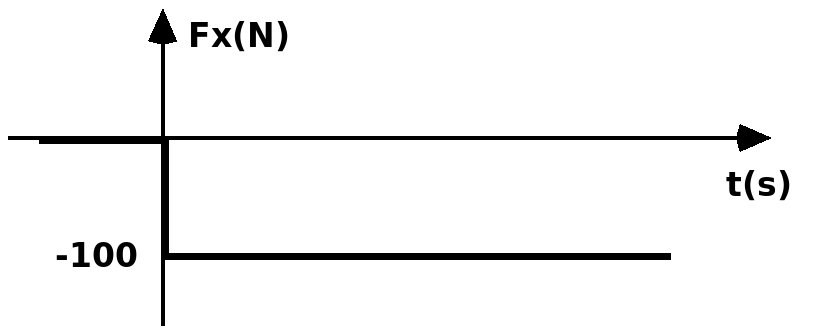
En \(\mathrm{N10}\) on applique une force constante à partir de l’instant \(t=0\) : \({F}_{x}=–100N\) .
1.4. Conditions initiales#
La structure est initialement au repos.