4. Modélisation B#
4.1. Caractéristiques de la modélisation#
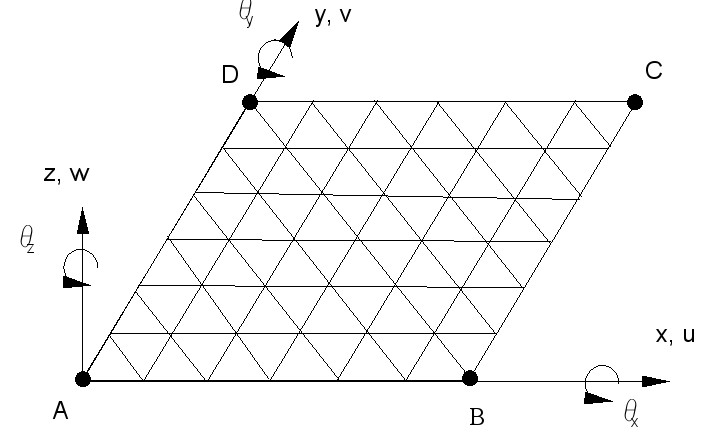
|
Modélisation DST (TRIA3)
|
4.2. Caractéristiques du maillage#
Nombre de nœuds : 49
Nombre de mailles et type : 72 TRIA3
4.3. Grandeurs testées et résultats#
Identification |
Type de Référence |
Valeur de Référence |
Tolérance |
Déplacement \(w\) au point \(C\) \((L/2,L/2,0)\) |
“SOURCE_EXTERNE” |
–0.07323 |
3% |
Contrainte \({\sigma}_{xx}\) au point \(C\) \((L/2,L/2,h/2)\) |
“SOURCE_EXTERNE” |
–0.478 |
4% |
Contrainte \({\sigma}_{yy}\) au point \(C\) \((L/2,L/2,h/4)\) |
“SOURCE_EXTERNE” |
–0.339 |
6.5% |
Contrainte \({\tau}_{xz}\) au point \(D\) \((0,L/2,0)\) |
“SOURCE_EXTERNE” |
–0.0203 |
12% |
Contrainte \({\tau}_{yz}\) au point \(B\) \((L/2,0,0)\) |
“SOURCE_EXTERNE” |
–0.0406 |
12% |