3. Modélisation A#
3.1. Caractéristiques de la modélisation A#
Le maillage de la plaque est composé en deux parties :
\(\mathrm{P1}\) , constitué d’un maillage non excentré
\(\mathrm{P2}\) , constitué de deux maillages superposés :
\(\mathrm{PLAQ}\text{\_}\mathrm{P1S}\) excentré de \(\mathrm{0.015m}\)
\(\mathrm{PLAQ}\text{\_}\mathrm{P1I}\) excentré de \(-\mathrm{0.035m}\)
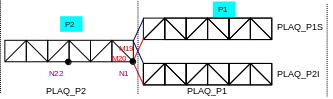
Modélisation DKT:
Nombre de nœuds |
\(26\) |
|||
Nombre de mailles |
\(39\) |
Soit: |
SEG2 |
\(3\) |
TRIA3 |
\(36\) |
Groupe de nœuds:
\(A,B,C,D,E,F,G,H\)
Groupe de mailles:
\(\mathrm{PLAQUE}\) : surface \(\mathrm{ACDF}\)
\(\mathrm{PLAQ}\text{\_}\mathrm{P1}\) : surface \(\mathrm{BCDE}\)
\(\mathrm{PLAQ}\text{\_}\mathrm{P2}\) : surface \(\mathrm{ABEF}\)
\(\mathrm{CD}\) : segment \(\mathrm{CD}\)
\(\mathrm{FA}\) : segment \(\mathrm{FA}\)
\(\mathrm{BE}\) : segment \(\mathrm{BE}\)
3.2. Résultat de la modélisation A#
Point |
Maille |
nœud |
Composante |
Référence |
Tolérance \((\text{\%})\) |
\(B\) |
\(\mathrm{N1}\) |
\(\mathrm{DZ}\) |
\(0.3515625m\) |
\(1.\) |
|
\(\mathrm{N1}\) |
\(\mathrm{DRZ}\) |
\(0.\) |
\(0.1\) |
||
\(\mathrm{M19}\) |
\(\mathrm{N1}\) |
\(\mathrm{MXX}\) |
\(-500000.\mathrm{m.N}\) |
\(3.\) |
|
\(\mathrm{M20}\) |
\(\mathrm{N1}\) |
\(\mathrm{MXX}\) |
\(-500000.\mathrm{m.N}\) |
\(5.\) |
|
\(G\) |
\(\mathrm{N22}\) |
\(\mathrm{DZ}\) |
\(-0.2629743m\) |
\(1.\) |
|
\(\mathrm{N22}\) |
\(\mathrm{DRZ}\) |
\(0.\) |
\(0.1\) |