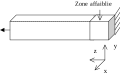
Loi de comportement |
Comportement élastique |
Comportement endommageant (partie saine) |
- Comportement endommageant
(zone affaiblie)
|
ENDO_ISOT_BETON |
- \(E=20000\mathit{MPa}\)
\(\nu =0\)
|
- \({\sigma}_{y}=6\mathit{MPa}\)
\({E}_{T}=-10000\mathit{MPa}\)
|
- \({\sigma}_{y}=5\mathit{MPa}\)
\({E}_{T}=-10000\mathit{MPa}\)
|
- ROUSS_PR
et
ROUSSELIER
|
- \(E=206400\mathit{MPa}\)
\(\nu =0.3\)
|
- \(D=2\)
\({\sigma}_{1}=490\mathit{MPa}\)
\({f}_{0}=5E-04\)
courbe de traction:

\(p\) : déformation plastique cumulée
\({r}_{i}=1500\mathit{MPa}\)
\({r}_{o}=520\mathit{MPa}\)
\(b=2.4\)
|
- \(D=2\)
\({\sigma}_{1}=400\mathit{MPa}\)
\({f}_{0}=5E-04\)
courbe de traction:

\(p\) : déformation plastique cumulée
\({r}_{i}=1500\mathit{MPa}\)
\({r}_{o}=520\mathit{MPa}\)
\(b=2.4\)
|
BETON_DOUBLE_DP |
- \(E=31000\mathit{MPa}\)
\(\nu =0.22\)
|
- \({f}_{c}=38.3\mathit{MPa}\)
\({f}_{t}=4.0\mathit{MPa}\)
\(\beta =1.16\)
\({G}_{t}=2.83E-04\mathit{Nmm}/{\mathit{mm}}^{2}\)
\({G}_{c}=2.83E-02\mathit{Nmm}/{\mathit{mm}}^{2}\)
|
- \({f}_{c}=38.3\mathit{MPa}\)
\({f}_{t}=3.0\mathit{MPa}\)
\(\beta =1.16\)
\({G}_{t}=2.83E-04\mathit{Nmm}/{\mathit{mm}}^{2}\)
\({G}_{c}=2.83E-02\mathit{Nmm}/{\mathit{mm}}^{2}\)
|
ENDO_LOCA_EXP |
- \(E=34129\mathit{MPa}\)
\(\nu =0\)
|
- \(\kappa =5.842\)
\(p=2\)
\({\sigma}_{c}=3.034\ast 1.5\mathit{MPa}\)
\({\sigma}_{0}=0.827\ast 1.5\mathit{MPa}\)
|
- \(\kappa =5.842\)
\(p=2\)
\({\sigma}_{c}=3.034\mathit{MPa}\)
\({\sigma}_{0}=0.827\mathit{MPa}\)
|