1. Problème de référence#
1.1. Géométrie#
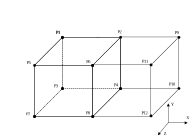
On définit les surfaces suivantes:
Face \(\mathrm{YZ1}\) : contenant les nœuds \(\mathrm{P1},\mathrm{P3},\mathrm{P5}\) et \(\mathrm{P7}\) .
Face \(\mathrm{YZ2}\) : contenant les nœuds \(\mathrm{P9},\mathrm{P10},\mathrm{P11}\) et \(\mathrm{P12}\) .
Face \(\mathrm{XY1}\) : contenant les nœuds \(\mathrm{P1},\mathrm{P2},\mathrm{P9},\mathrm{P3},\mathrm{P4}\) et \(\mathrm{P10}\) .
Face \(\mathrm{XY2}\) : contenant les nœuds \(\mathrm{P5},\mathrm{P6},\mathrm{P11},\mathrm{P7},\mathrm{P8}\) et \(\mathrm{P12}\) .
Face \(\mathrm{XZ1}\) : contenant les nœuds \(\mathrm{P3},\mathrm{P4},\mathrm{P10},\mathrm{P7},\mathrm{P8}\) et \(\mathrm{P12}\) .
Face \(\mathrm{XZ2}\) : contenant les nœuds \(\mathrm{P1},\mathrm{P2},\mathrm{P9},\mathrm{P5},\mathrm{P6}\) et \(\mathrm{P11}\) .
et les éléments suivants:
Elément \(\mathrm{M1}\) : contenant les nœuds \(\mathrm{P1},\mathrm{P2},\mathrm{P3},\mathrm{P4},\mathrm{P5},\mathrm{P6},\mathrm{P7}\) et \(\mathrm{P8}\) .
Elément \(\mathrm{M2}\) : contenant les nœuds \(\mathrm{P2},\mathrm{P9},\mathrm{P4},\mathrm{P10},\mathrm{P6},\mathrm{P11},\mathrm{P8}\) et \(\mathrm{P12}\) .
1.2. Propriétés de matériaux#
Deux matériaux sont utilisés:
Matériau \(\mathit{MAT1}\) attribué à l’élément \(\mathrm{M1}\) :
Module d’Young : \(\mathit{E1}=200000\mathit{MPa}\)
Coefficient de Poisson : \({\nu}_{1}=0.3\)
Matériau \(\mathit{MAT2}\) attribué à l’élément \(\mathrm{M2}\) :
Module d’Young : \(\mathrm{E2}=100000\mathrm{MPa}\)
Coefficient de Poisson : \({\nu}_{2}=0.3\)
1.3. Conditions aux limites et chargements#
Premier calcul:
C’est un calcul de traction simple suivant la direction \(X\) :
On impose une déformation élastique linéaire \({\varepsilon}_{xx}=1\) sur la surface \(\mathrm{YZ2}\) .
La surface \(\mathrm{YZ1}\) ne se déplace pas suivant la direction \(X\) .
Deuxième calcul:
C’est un calcul de traction simple suivant la direction \(Y\) :
On impose une déformation élastique linéaire \({\varepsilon}_{yy}=1\) sur la surface \(\mathrm{XZ2}\) .
La surface \(\mathrm{XZ1}\) ne se déplace pas suivant la direction \(Y\) .