1. Problème de référence#
1.1. Géométrie#
Une plaque carrée, constituée d’un matériau orthotrope incliné de 30 degrés par rapport à l’arête \(\mathrm{AB}\) .
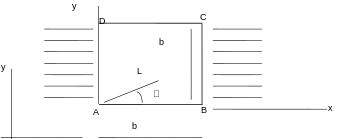
Avec \(b=1m\) , épaisseur quelconque (contraintes planes), angle d’orthotropie: \(\theta\) = 30 degrés.
1.2. Propriétés des matériaux#
Les propriétés des matériaux constituant la plaque sont:
élastique orthotrope:
\({E}_{L}=4.E10\mathrm{Pa}\)
\({E}_{T}=1.E10\mathrm{Pa}\)
\({G}_{LT}=0.45E10\mathrm{Pa}\)
\({G}_{\mathrm{TN}}=0.35E10\mathrm{Pa}\)
\({\mathit{NU}}_{LT}=0.3\)
L’axe \(L\) est incliné de 30 degrés par rapport à \(\mathrm{AB}\) .
1.3. Conditions aux limites et chargements#
Au point \(A\) : \(\mathrm{DX}=0\) , \(\mathrm{DY}=0\)
Au point \(B\) : \(\mathrm{DX}=0\) ,
Chargement linéique réparti: \(\mathrm{Fx}={10}^{4}\mathrm{Pa}\) sur \(\mathrm{BC}\)
Chargement linéique réparti: \(\mathrm{Fx}=-{10}^{4}\mathrm{Pa}\) sur \(\mathrm{DA}\)
1.4. Conditions initiales#
Sans objet.