1. Problème de référence#
1.1. Géométrie#
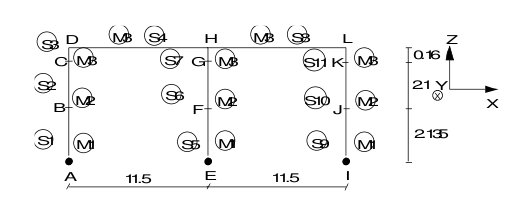
Sections transversales de poutres:
charpente support
\(\mathrm{S1}\) : |
\(A=1.2061{10}^{-2}{m}^{2}\) |
\({I}_{z}=2.3681{10}^{-5}{m}^{4}\) |
\(\mathrm{S5}\) : |
\(A=1.4621{10}^{-2}{m}^{2}\) |
\({I}_{z}=2.8709{10}^{-5}{m}^{4}\) |
\(\mathrm{S9}\) : |
\(A=1.5530{10}^{-2}{m}^{2}\) |
\({I}_{z}=3.0493{10}^{-5}{m}^{4}\) |
colonnes isolantes
\(\mathrm{S2}\) : |
\(A=3.1428{10}^{-2}{m}^{2}\) |
\({I}_{z}=4.5070{10}^{-5}{m}^{4}\) |
\(\mathrm{S6}\) : |
\(A=3.2592{10}^{-2}{m}^{2}\) |
\({I}_{z}=4.6738{10}^{-5}{m}^{4}\) |
\(\mathrm{S10}\) : |
\(A=3.3416{10}^{-2}{m}^{2}\) |
\({I}_{z}=4.7927{10}^{-5}{m}^{4}\) |
raccords
\(\mathrm{S3},\mathrm{S11}\) : |
\(A=3.1944{10}^{-2}{m}^{2}\) |
\({I}_{z}=1.15{10}^{-5}{m}^{4}\) |
\(\mathrm{S7}\) : |
\(A=4.2130{10}^{-2}{m}^{2}\) |
\({I}_{z}=1.15{10}^{-5}{m}^{4}\) |
conducteurs
\(\mathrm{S4},\mathrm{S8}\) : |
circulaire \(R=6.055{10}^{-2}m\) |
\(e=6.2{10}^{-3}m\) |
1.2. Propriétés de matériaux#
\(\mathrm{M1}\) : |
\(E=2.{10}^{11}\mathrm{Pa}\) |
\(\rho =8000\mathrm{kg}/{m}^{3}\) |
(charpente support) |
\(\mathrm{M2}\) : |
\(E=5.{10}^{10}\mathrm{Pa}\) |
\(\rho =2500\mathrm{kg}/{m}^{3}\) |
(colonne isolante) |
\(\mathrm{M3}\) : |
\(E=7.{10}^{10}\mathrm{Pa}\) |
\(\rho =2700\mathrm{kg}/{m}^{3}\) |
(raccord et conducteur aluminium) |
1.3. Conditions aux limites et chargements#
Points \(A\) , \(E\) , \(I\) : encastrement
Points \(D\) , \(L\) : non-continuité de \({u}_{x}\) , \({\theta}_{y}\) , \({\theta}_{z}\)
Forces de Laplace sur les conducteurs \(\mathrm{DH}\) , \(\mathrm{HL}\) ;
courant biphasé \(\phi =\omega =100m\)
conducteurs infinis séparés de \(1m\)
\(I={I}_{\mathit{eff}}\sqrt{2}(\cos(\omega t+\phi )-{e}^{-t/\tau }\cos\phi )\)
\({I}_{\mathrm{eff}}\) intensité efficace du courant
\(\tau\) constante de temps
deux court-circuit avec réenclenchement
\(t\) |
\(0<t\le 0.135\) |
\(0.135<t<0.580\) |
\(0.580\le t\le 0.885\) |
\({I}_{\mathrm{eff}}\) |
\(15.6\mathrm{kA}\) |
\(0\) |
\(15.6\mathrm{kA}\) |
\(\tau\) |
\(0.066s\) |
\(0.062s\) |
1.4. Conditions initiales#
\(t=0\) , vitesse et accélération nulles.