1. Problème de référence#
1.1. Géométrie#
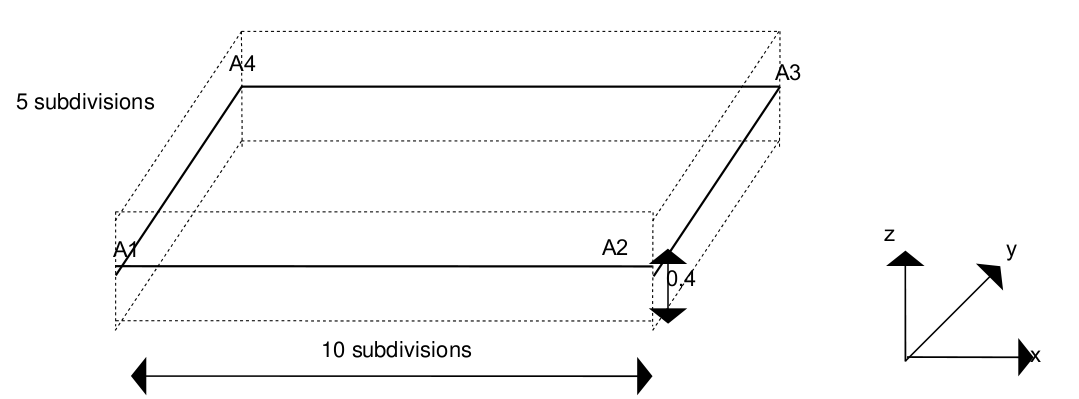
coordonnées des points (en \(m\) ): \(\mathrm{A1}(0,0,0)\) \(\mathrm{A2}(10,0,0)\) \(\mathrm{A3}(10,5,0)\) \(\mathrm{A4}(0,5,0)\)
1.2. Propriétés de matériaux#
Le matériau est constitué de 4 couches orthotropes d’épaisseur 0.1.
La première couche est caractérisée par:
\(\mathrm{EL}={20000.10}^{6}\mathrm{Pa}\) |
\(\mathrm{ET}={20000.10}^{6}\mathrm{Pa}\) |
\(\mathrm{VLT}=0.3\) |
\(\mathrm{GLT}={2000.10}^{6}\mathrm{Pa}\) |
la seconde couche par:
\(\mathrm{EL}={15000.10}^{6}\mathrm{Pa}\) |
\(\mathrm{ET}={15000.10}^{6}\mathrm{Pa}\) |
\(\mathrm{VLT}=0.3\) |
GLT = 1500.10^6Pa |
la troisième couche par:
\(\mathrm{EL}={20000.10}^{6}\mathrm{Pa}\) |
\(\mathrm{ET}={20000.10}^{6}\mathrm{Pa}\) |
\(\mathrm{VLT}=0.3\) |
\(\mathrm{GLT}={2000.10}^{6}\mathrm{Pa}\) |
et la quatrième couche par:
\(\mathrm{EL}={15000.10}^{6}\mathrm{Pa}\) |
\(\mathrm{ET}={15000.10}^{6}\mathrm{Pa}\) |
\(\mathrm{VLT}=0.3\) |
\(\mathrm{GLT}={1500.10}^{6}\mathrm{Pa}\) |
1.3. Conditions aux limites et chargements#
Le nœud \(\mathrm{A1}\) est encastré:
\(\mathrm{dx}=0.\) |
\(\mathrm{dy}=0.\) |
\(\mathrm{dz}=0.\) |
\(\mathrm{dRx}=0.\) |
\(\mathrm{dRy}=0.\) |
\(\mathrm{dRz}=0.\) |
Le nœud \(\mathrm{A2}\) est bloqué selon les ddls suivants:
\(\mathrm{dx}=0.\) |
\(\mathrm{dy}=0.\) |
On applique une force modale \(\mathrm{Fz}=-\mathrm{1000.N}\) sur le nœud \(\mathrm{A3}\) .