1. Problème de référence#
1.1. Géométrie#
Un modèle de rotor supporté par 2 paliers (nœuds \(\mathrm{B1}\) et \(\mathrm{B2}\) sur la figure ci-dessous), dont les matrices de raideur et d’amortissement sont non symétriques. Il est composé de 3 disques et 4 sections d’arbre.
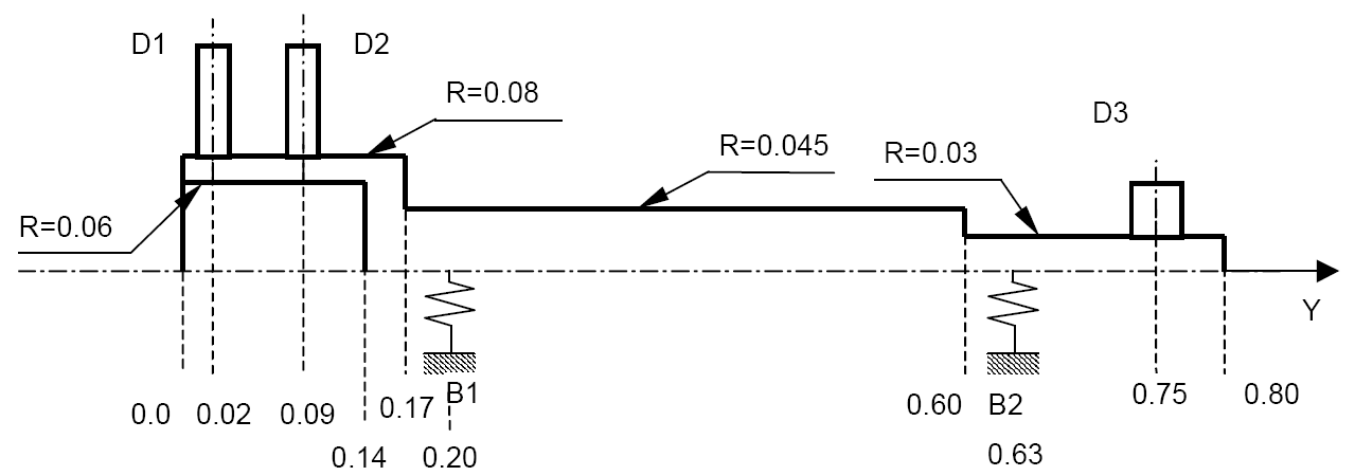
1.2. Propriétés du matériau#
Les caractéristiques géométriques et matériau sont listées dans le tableau suivant.
Matériau |
\(E=2{10}^{11}N/{m}^{2}\) |
\(\rho =7800\mathrm{kg}/{m}^{3}\) |
\(\nu =0.3\) |
|
Disque |
\(\mathrm{D1}\) |
\(M=20\mathrm{kg}\) |
\({I}_{D}=0,20\mathrm{kg}{m}^{2}\) |
\({I}_{P}=0,40\mathrm{kg}{m}^{2}\) |
\(\mathrm{D2}\) |
\(M=17\mathrm{kg}\) |
\({I}_{D}=0,17\mathrm{kg}{m}^{2}\) |
\({I}_{P}=0,34\mathrm{kg}{m}^{2}\) |
|
\(\mathrm{D3}\) |
\(M=10\mathrm{kg}\) |
\({I}_{D}=0,015\mathrm{kg}{m}^{2}\) |
\({I}_{P}=0,30\mathrm{kg}{m}^{2}\) |
|
Les caractéristiques des paliers varient linéairement en fonction de la vitesse de rotation :
à \(5000\mathrm{tr}/\min\) :
Palier |
\(\mathrm{P1}\) |
\(\mathrm{kyy}=9{10}^{7}N/m\) |
\(\mathrm{kzz}=5{10}^{8}N/m\) |
\(\mathrm{kyz}=9{10}^{4}N/m\) |
\(\mathrm{kzy}=-9{10}^{4}N/m\) |
||
\(\mathrm{cyy}=1,5{10}^{5}\mathrm{Ns}/m\) |
\(\mathrm{czz}=4.5{10}^{5}\mathrm{Ns}/m\) |
||
\(\mathrm{cyz}=-1{10}^{2}\mathrm{Ns}/m\) |
\(\mathrm{czy}=1{10}^{2}\mathrm{Ns}/m\) |
||
Palier |
\(\mathrm{P2}\) |
\(\mathrm{kyy}=6{10}^{7}N/m\) |
\(\mathrm{kzz}=1,5{10}^{8}N/m\) |
\(\mathrm{kyz}=8{10}^{4}N/m\) |
\(\mathrm{kzy}=-8{10}^{4}N/m\) |
||
\(\mathrm{cyy}=1,2{10}^{5}\mathrm{Ns}/m\) |
\(\mathrm{czz}=1,9{10}^{5}\mathrm{Ns}/m\) |
||
\(\mathrm{cyz}=-1{10}^{2}\mathrm{Ns}/m\) |
\(\mathrm{czy}=1{10}^{2}\mathrm{Ns}/m\) |
à \(6500\mathrm{tr}/\min\) :
Palier |
\(\mathrm{P1}\) |
\(\mathrm{kyy}=1{10}^{8}N/m\) |
\(\mathrm{kzz}=4{10}^{8}N/m\) |
\(\mathrm{kyz}=1,5{10}^{5}N/m\) |
\(\mathrm{kzy}=-1,5{10}^{5}N/m\) |
||
\(\mathrm{cyy}=1,3{10}^{5}\mathrm{Ns}/m\) |
\(\mathrm{czz}=3.3{10}^{5}\mathrm{Ns}/m\) |
||
\(\mathrm{cyz}=-1{10}^{2}\mathrm{Ns}/m\) |
\(\mathrm{czy}=1{10}^{2}\mathrm{Ns}/m\) |
||
Palier |
P2 |
\(\mathrm{kyy}=7{10}^{7}N/m\) |
\(\mathrm{kzz}=1,4{10}^{8}N/m\) |
\(\mathrm{kyz}=1,3{10}^{5}N/m\) |
\(\mathrm{kzy}=-1,3{10}^{5}N/m\) |
||
\(\mathrm{cyy}=1{10}^{5}\mathrm{Ns}/m\) |
\(\mathrm{czz}=1,5{10}^{5}\mathrm{Ns}/m\) |
||
\(\mathrm{cyz}=-1{10}^{2}\mathrm{Ns}/m\) |
\(\mathrm{czy}=1{10}^{2}\mathrm{Ns}/m\) |
1.3. Conditions aux limites#
Pour bloquer les mouvements de type corps rigide dans la direction \(x\) , on bloque le degré de liberté \(\mathrm{DX}\) au nœud palier \(\mathrm{B1}\) .