1. Problème de référence#
1.1. Géométrie#
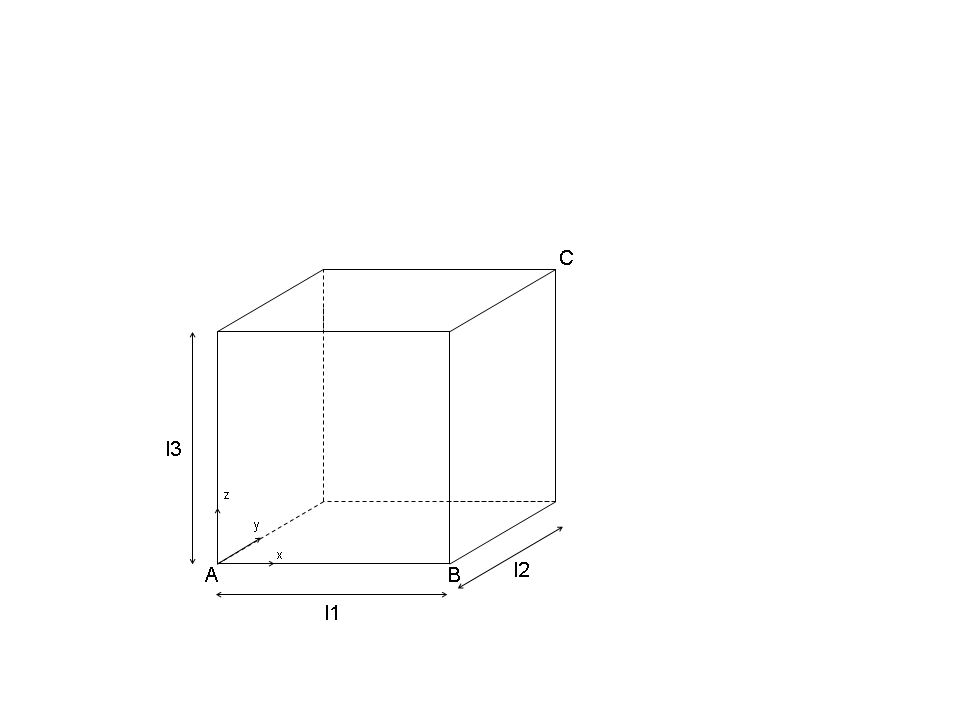
Coordonnées des points \((m)\) :
\(A:(0.,0.,0.)\)
\(B:(10.,0.,0.)\)
\(C:(10.,10.,10.)\)
Géométrie du cube \((m)\) :
\(\mathrm{l1}=\mathrm{l2}=\mathrm{l3}=10.\)
Groupe de mailles :
\(\mathrm{base1}\) : surface inférieure du cube (plan \(\mathrm{XOY}\) )
1.2. Propriétés du matériau#
\(E=1.0\mathrm{E5}N/{m}^{2}\)
\(\nu =0.3\)
\(\rho =9800.\mathrm{Kg}/{m}^{-3}\)
1.3. Conditions aux limites et chargements#
Déplacements imposés :
\(\mathrm{base1}\) : \(\mathrm{DX}=10.\) , \(\mathrm{DY}=\mathrm{DZ}=0.\)
Chargement imposés :
Gravité selon \(-z\) \(g=9.81{\mathrm{ms}}^{-2}\)