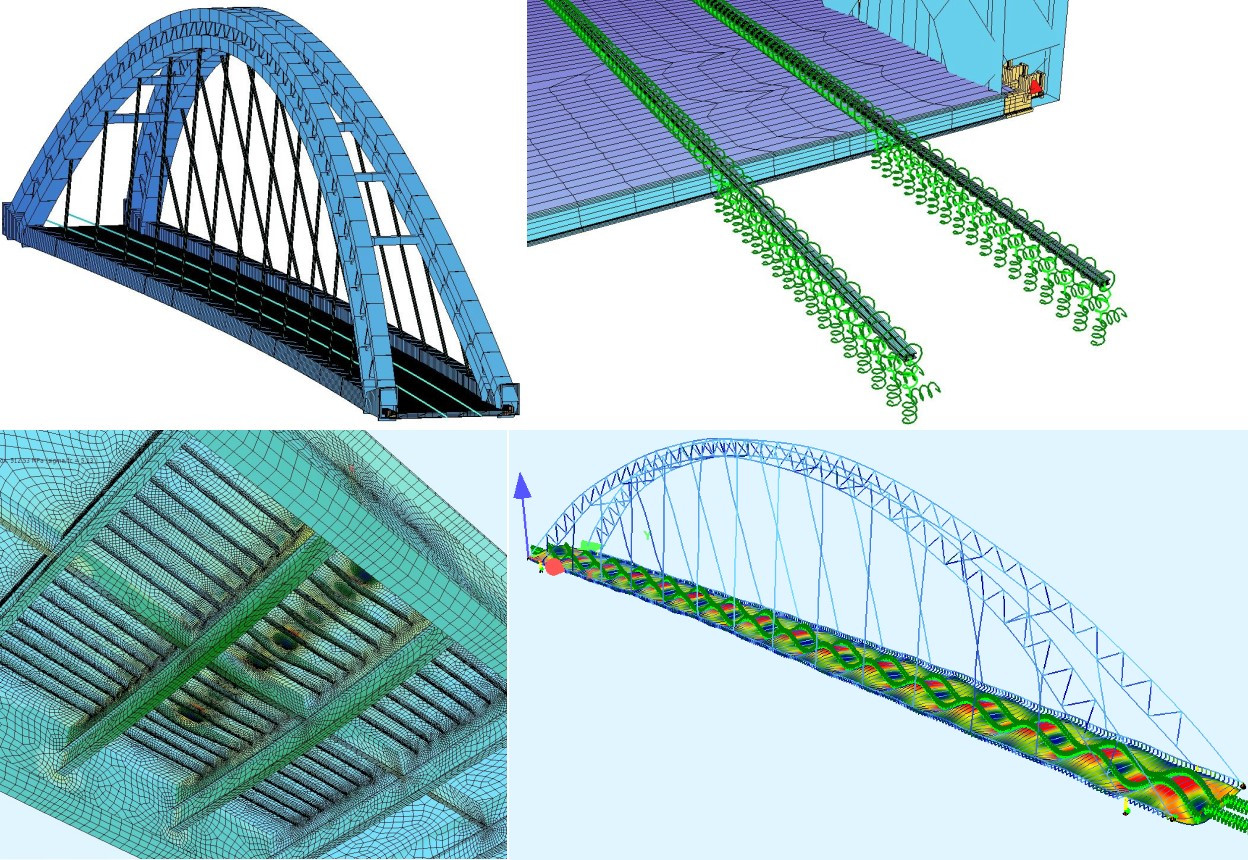
I am going to start learning Code-Aster/Salome-Meca for structural modelling. I have some years of experience using other structural engineering software like Sofistik, RFEM, Ansys, etc. I am wondering if Code-Aster is capable of doing the job. For example, modelling an steel-concrete composite bridge composed of 1D beam/cable elements and 2D shell elements and performing buckling eigenvalue anslysis. A model similar to the image below.
When I think about modelling for example a 3D lattice tower for high-voltage power lines with many steel L-profiles that are eccentric connected to each other, and each has a different local axes, it seems modelling of such a structure with Salome-meca is very difficult, and checking the model by visualisation of the cross-sections is very hard. Is my understanding correct?
Afterward, checking the results, for example checking the results of a buckling eigenvalue analysis where I would like to see the buckling modes, whether a member (steel L-profile) is buckling in torsion or in bending, is also not simple.
My impression is that code-aster is probably not very well suited for the design phase of a steel structure, where we are in the design phase and would like to change the concept of the structure and members many times till we come to a final design. While these changes are very easy and quick in commercial structural analysis software like SAP2000, doing the same thing in code-aster is difficult. I couldn’t find any example of modelling a large scale steel structure with 1D and 2D elements with code-aster in the Internet; additionally this impression is base on my very limited use of salome-meca/code-aster. Am I right?
For example this video from time 5’:00" to 7’:00" shows the procedure to generate one single steel L-section member. It is a lot of work in comparison with commercial programs like SAP2000.
from my limited experience (albeit a few decade) i found out that the combination Gmsh code_aster (both with their highly scriptable capabilities) was for me the best suited to preliminary design with many iterations changing a bit here and or a bit there
Are you aware of any use cases of code-aster for large steel bridges? For example, cable stay bridges with an orthotropic steel deck or a steel-concrete composite deck.
I wouldn’t use Code_Aster for structures which can be modeled with beam elements. There are much better and faster commercial solutions, which are specifically tailored for this purpose where design is constantly changing and you need the ease of use, good visualization and integrated code-checks. And these software packages are rather cheap for what they give, so it doesn’t make financial sense to try use Code_Aster.
You should consider Code_Aster as a substitute for general-purpose FEA softwares (like Abaqus, Ansys, NX Nastran) not for civil engineering FEA softwares (like Sofistik, RFEM, Robot). Trying to substitute civil engineering FEA software with Code_Aster is just going to give you a headache, it’s not worth it in a real fast-paced professional setting.
But for shell and solid elements, especially with nonlinearities, Code_Aster is more than capable albeit more difficult to use than commercial general-purpose packages. User experience is obviously not the highest priority in an open-source solver and you have to accept that. But these general-purpose packages cost five to six figures a year, while Code_Aster costs nothing. And every program has a learning curve and their drawbacks, no matter is it open-source or commercial. Also commercial software is not always necessarily better to solve your particular problem.
EDIT: The video you provided doesn’t really tell anything about how “slow” Code_Aster is. I don’t understand why the video maker is modelling a truss structure like that, looks highly inefficient and overly complicated (for example drawing a L-shape and then extruding it???). Also what he does in the video is just (very poor) geometry editing, that has nothing to do with Code_Aster, it could be done with any CAD-software. There are a lot of very bad video tutorials on YouTube, where they basically just show how to click stuff but there is very little sense in what they actually do.
The integration of civil engineering features into ASTER is very well implemented in a tool called “Civil Master,” which offers, in particular, a superb graphical interface while still allowing for highly advanced calculations and even rebar design.
Unfortunately, this tool is not open source and is intended to be “sold” (as if EDF were a software publisher…). This is regrettable.
How to find more info about this Civil Master? I found the website, should I leave an inquiry there? I’m a small engineering consultancy business owner (<10 people), but I’m currently the only one capable using Code_Aster. Just saying this to show that I’m not a hobbyist and won’t be wasting your time, I understand it is a paid solution. But I would be interested to find out could it speed up our higher-end analysis projects to justify the cost.
I would suggest you tussle with code_aster for a while. You seem to be motivated by big meshes and colorful data but that kind of motivation is not helpful for long. First you spend 1000 hrs learning/struggling with code_aster through boring test cases. Maybe then you perception might change.
Cable elements, beams, DKT shells etc are all well supported in aster and can capture complex physics with large deformations including beam warpage. local orientation axes and custom beam cross section can be included and printed for viewing in paraview.
Additionally you can include thermal effects. I am not into civil engineering domain but I once did a simulation of railway tracks made entirely of beam elements and the goal was to predict thermal expansion (and consequently thermal distortion) due to temperature cycle of sun exposure cycle for 16 hrs.
The results were surprisingly good. I Did this for a engineer of INGEROP in France.
I would be happy if you would like me to use and test your program (Civil Master) as an industrial user and give advice on the features of your program. I have +20 years of experience in the design and design verification of steel structures (bridges, pylons, monopoles, industrial buildings, ship lock gates, etc.) using different programs like Sofistik, RFEM, Robot, SAP2000, ANSYS, SCIA.
I’m not sharing my experience to oversell myself, but simply to give a little more context about my background and where I might be able to contribute.